

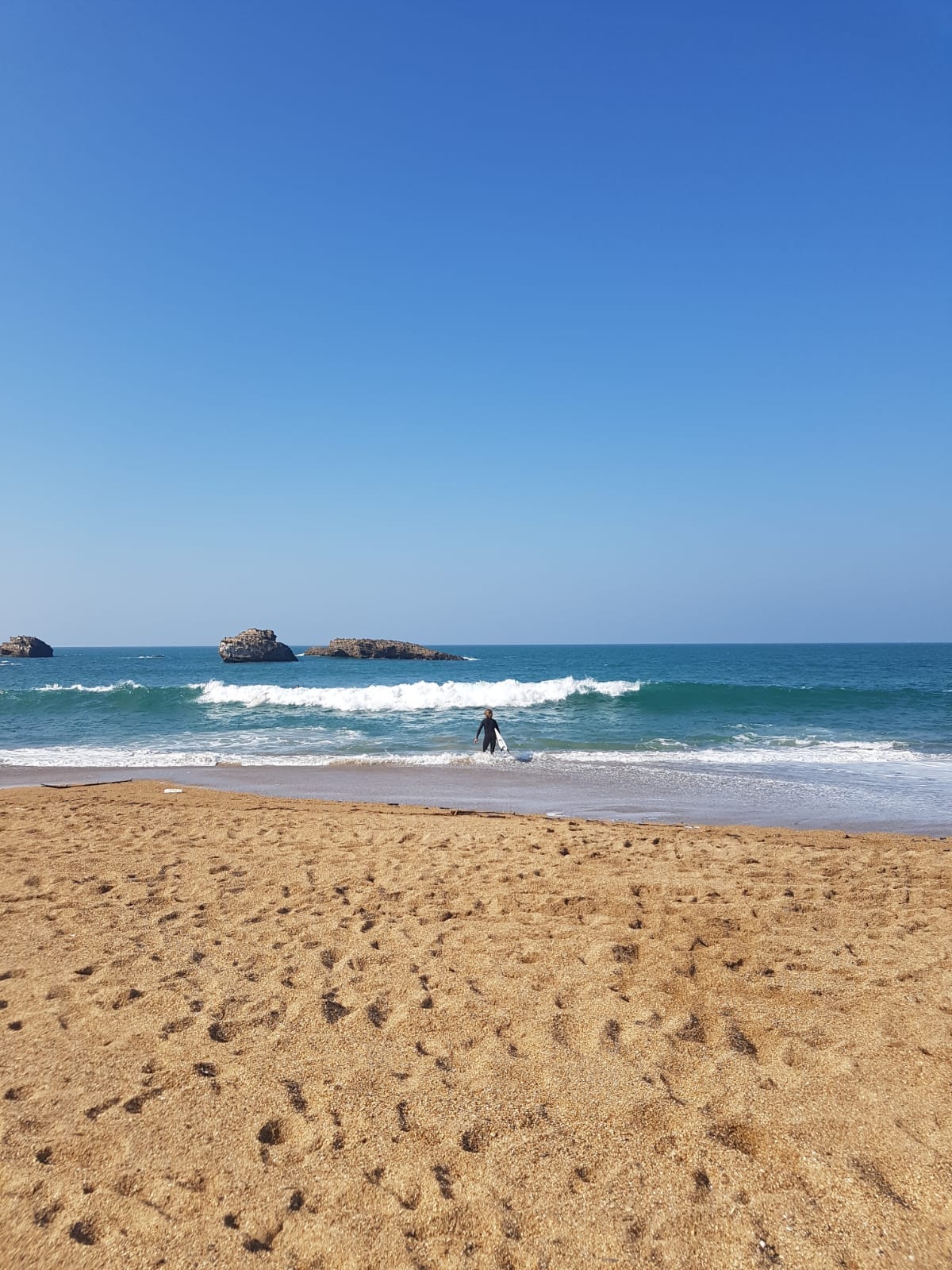
Immersion 4: Grande Plage, Biarritz

The sea has a rage like no man
Or girl
Some say it has no rage at all.

There is no great truth to unfurl
Or scan
In the way the waves buffet a fool.

Was it not some hidden wrath
It was surely hidden malice
That rolled me in the bone-white froth,
Trapped me in a bone-white palace?

What I know now
Dislodges what went before
When I sunk into the quiet slough
Which I'm a stranger to for evermore.

Waking up from a deep, deep sleep is not as pleasant nor as fortifying for a morning as words on a page would make it seem. The depth of sleep is proportional to the severity of the shock of waking. Those who live or work in environments with very low levels of sunlight, a cave for instance, take a while to adapt to environments with very high levels of sunlight. This is akin to waking from very sound sleep.

These are the mornings when most I wish to preserve the seclusion of my dreams and my sleepworld — they try harder than ever to ingratiate themselves with my other lives that I live when I awake. Perhaps it's a peculiar kindness, helping me adapt to the light.

Since a lot of life is sleep, since a lot of life is being told that sleeping soundly is essential and healthy, and since, euphemistically speaking, a lot of pre-life and post-life is sleep, this is a problem. Sleeping makes living hard and vice versa as darkness makes light hard and vice versa. One new experience sweeps away the feeling of the experience preceding it like declarations of love written in wet sand before the approaching wave. And this appears to unsettle the rhythm of things.

I must sleep well and live well. I must not get too attached to either. I must make the opposites cohere. My eyelids must close and open with the same gusto.

How can they devour the light who rummage so deep for their sequestered roots?
Where to begin? — that was the question; at what point to make the first mark? One line placed on the canvas committed her to innumerable risks, to frequent and irrevocable decisions. All that in idea seemed simple became in practice immediately complex; as the waves shape themselves symmetrically from the cliff top, but to the swimmer among them are divided by steep gulfs, and foaming crests. Still the risk must be run; the mark made.
— V. Woolf, To the Lighthouse
I sit myself down. Beyond the reach of the sea's salty breath. It foams at the mouth and hasn't cleaned its teeth for days. It smiles furiously at me as I bring a small camera to my squinting eye.

In the little window that displays the scene I am groping to capture, life plays out with uncommon artfulness. Don, my dear companion, my Virgil leading me through the sun-kissed inferno of appearances coating the southwest of France as Winter greets Spring, steps towards the sparkling blue with more heroism than the naked eye can discern. The camera's eye modulates how much light this moment may be exposed to and deploys heavy shadows where the hero and his surfboard entangle themselves between sun and sea.

I have a need for light, but how much light am I willing to expose myself to? Will I accept what that light shines on me in the same way I run to what that light shines on the objects of my desires? And when I see the light that draws me out will I try to trap it in the darkness of my clenched fists or will I greet it with an open palm?

For a time I watch Don. He steps above the waves, sometimes momentarily, sometimes for a series of moments, and sometimes he misses the beat altogether — never steps above at all. Always though, he looks back to shore to see if I am watching and to see who else is watching.

What the camera lens does not say, but the squinting eye distinguishes as plainly as black contrasts white, is that in the thick of the waves the hero feels exposed to the whole world. Maybe no one but me is watching him, but that isn't how it feels — not when a disobedient tuft of wave jerks the board out from beneath the all-mastering feet, unrooting the hero.

In the most selfish kind of solidarity, I leave my litter of possessions on the beach — a towel, a book, a pen, a notebook, the camera (eyelid now shut) — and feel the sand change in firmness as I get closer to the monster's jaws where Don dances with hope. Over my shoulder, the distant rumbling of petanque players saunters down the cliffs and I can distinctly imagine the old-aged hollering and whooping as one metal ball thunders into another, fizzing it out of the arena forever. Now just in front of me, the waves cheer and clap with the same kind of glee I just imagined. Two of them converge on Don's hitherto untroubled board and the applause drowns out the plop of the hero's sudden submergence.

How can they find their way who have never faced the need to alchemise land and water?

The plage and its sea collude in a fiendish plot. Lured to the place where, together, they are most potent I find out my folly too late. Up to my waist in the restorative blue I turn to inspect the aspect of the shore as one might look at Earth from the moon. Quickly the tide empties until there is only a small puddle splashing about my ankles. I have been stripped of something, I stand naked in front of the beach, exposed to all and sundry. Checking to find the source of this moment of shame, I partake of the feeling of horror all earthlings experience in the face of certain death. The shallow water and the sand scurries and sinks across my feet and looming overhead is a mass of the sea's great heft, oblivious to the morsel it is about to consume.

Shock opens the mouth wide. Very wide. Wide enough to permit a volume of water that isn't enough to drown a person but enough to make a person wonder if drowning might be a more pleasurable option. It's also enough water to knock a person off their stable footing. And this is where the waves can have their play. I flip onto my back in an instant, not that I know it, having my tummy tickled by a counter current at the same time. Underwater, the push and the pull of all these excitable forces do not leave me stretched out how I expect them to, but rather they intimidate me into a foetal ball of protection — they return me to a childlike state.

By and by, the sea vomits me out. It may be less than a minute, or it may be a lifetime of uncontrollable rolling, before I regain my feet unsteadily and crawl back to the safety of the shore. This time I am glad. Glad for the ephemera. Glad to know the sea only enough to know its inexplicability. I am glad to witness that to know things as they are requires exposure to a painful, and inhuman, degree. Above all, I'm glad to know that awe is the thrill of finding myself exposed to the parts of reality that are resistant to my thinking.

What have they grasped whose thoughts fit smally in the dark of their clutched fingers?

To get here, I have walked so far believing myself to be mired in the most unnavigable slough, far below the smooth pavement of my peers. But this has never been so.

This was a single photographic exposure I took to be in a condition of living and it demented me, shouldering me out from my own instant.

The pause in the symphony is not the absence of sound, nor merely a precursor to what comes next — it too is its own kind of voicing.

The exposure, the pause, the immersion — a million of these aren't enough. Like a cheese sandwich, like a kiss, these are endlessly recitable moments that never get boring.

Feeling dry, soft sand beneath my feet once more, the terror of the sea begins its slow dissipation from my body. A pinprick of colour dares to surface on my pale cheeks. The camera only shakes lightly in time with the aftershock of my trembling hands. There isn't time to notice these things before I am conversing with my fellow earthling:

"Did you see me out there? We came at the wrong time of day for the best waves. Oh well, time for a late lunch I think — fancy a cheese sandwich or something?" asked Don.
Conclusion of the fourth immersion
What a lovely piece. That don fellow sounds great too